
Crystal Quest Water Filter Review: Is It Worth It?
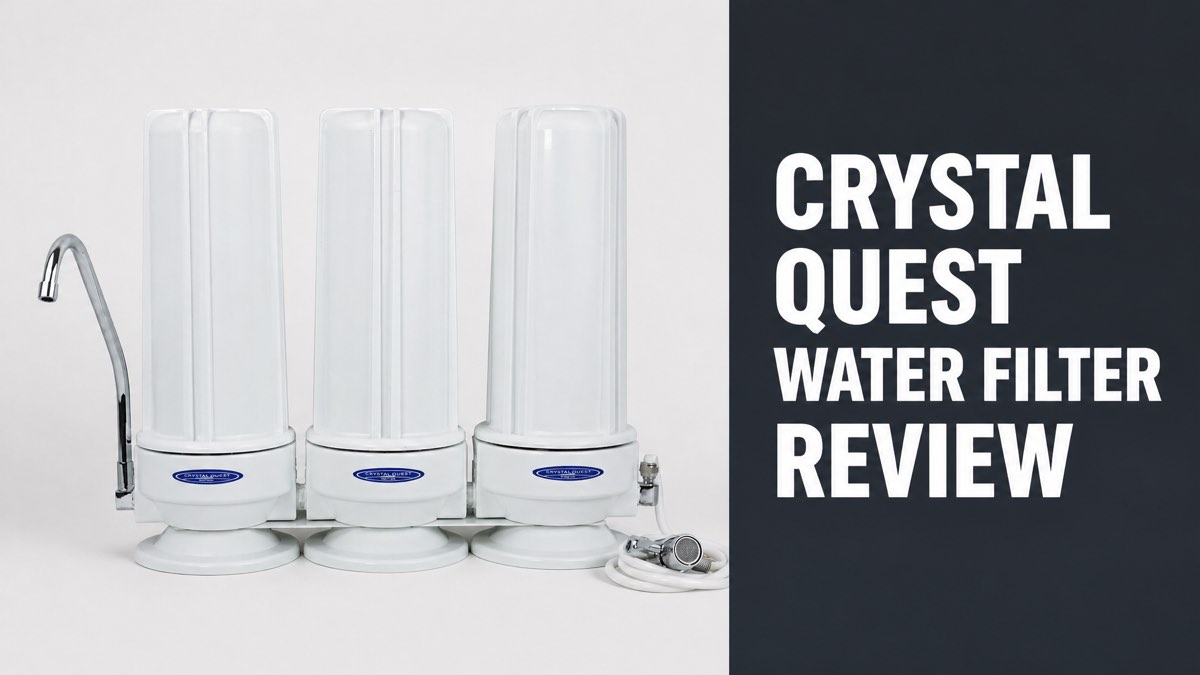
Crystal Quest is a Georgia water filter maker that sells pitchers, countertop units, under-sink systems and whole-house tanks. Quest Technologies has built them since 1994, and the kitchen range starts at $39.95.
The filters pass water through sediment, carbon and alloy stages. Chlorine reduction has real lab support. No finished system holds an NSF, IAPMO or WQA listing, though. Buyers praise taste and easy hookup, and complain about fittings and a one-year warranty.
Price and speed shape the verdict too. The countertop RO is slow and wasteful, while the under-sink line moves 0.5 gallons a minute. Read on to see what each model costs, how often cartridges change and who should look at certified rivals instead.
What Is a Crystal Quest Water Filter?
A Crystal Quest water filter is a home filtration product from a Georgia manufacturer that sells everything from pitchers to whole-house tanks. Most systems use the brand's own copper-zinc media, paired with carbon and sediment stages.
For a kitchen, four formats matter: pitcher, countertop, under-sink and inline. Each one comes from the same company, so a buyer can stay with one brand as needs grow. Such breadth is rare for a consumer filter maker.
Who Makes Crystal Quest Water Filters?
Quest Technologies, Inc. makes Crystal Quest filters at a single site in Kennesaw, Georgia. The company has traded since 1994 and stays privately held. Mike Sigari founded it and still serves as CEO.
The factory holds a current ISO 9001:2015 quality registration, and each product is assembled in the United States. Registration covers process quality. To be clear, the registration does not replace a finished-product filter certification, a gap covered further down.
How Does a Crystal Quest Water Filter Work?
A Crystal Quest filter pushes tap water through a stack of stages, each aimed at a different problem. Sediment pads catch grit first. Carbon then handles chlorine and taste, and redox alloy and resin stages target metals.
One-micron pads sit at the front and back of the multi-stage cartridges. One micron catches silt and rust particles before they reach the carbon. Clean carbon works longer, so the pads protect the more expensive media.
Specialty cartridges extend the same housing. Fluoride, arsenic and nitrate versions fit the countertop and RO units. Buyers add them only when a water test shows the need.
What Is SMART Media?
SMART media is the brand's blended filter fill, built from two kinds of coconut shell carbon plus metal alloys. The carbon comes as a standard grade and a catalytic grade. The catalytic grade handles chloramine better than plain carbon.
Eagle Redox Alloy 6500 and 9500 sit inside that blend, along with ion exchange resin. Those alloys target heavy metals such as lead and mercury. Why add an alloy to carbon? The alloy keeps the carbon bed from growing bacteria. Ceramic balls round out the mix.
Which Crystal Quest Filters Suit a Kitchen?
The countertop and under-sink lines fit most kitchens, and the pitcher suits the smallest budget. Renters usually pick countertop units because nothing permanent gets installed. Owners often choose under-sink to free the counter.
Prices climb with stage count. The pitcher starts at $39.95, while the triple countertop reaches $154.80. Here is how the common kitchen options stack up.
Kitchen Options at a Glance:
| Model | Type | Starting Price |
|---|---|---|
| Gravity pitcher | Pitcher | $39.95 |
| SMART Countertop Single | Countertop | $86.90 |
| SMART Countertop Triple | Countertop | $154.80 |
| 80,000 Gallon Countertop Single | Countertop | $199 |
| SMART Under Sink Single | Under-sink | $149.90 |
| Thunder 1000C | Under-sink RO | $298.40 |
How Does the Thunder Countertop RO Perform?
The Thunder countertop RO makes clean-tasting water slowly and shows weak lab results. The unit runs ten stages, connects to a standard faucet with a diverter, and needs no storage tank. A pitcher or container catches the water as it forms.
The membrane is rated at 50 gallons per day (190 liters) at 60 psi. At normal kitchen pressure the real output drops to about 25 gallons (95 liters) a day. The result is 0.02 gallons a minute. A lab measured about 72 minutes per cup.
The same lab measured a pure-to-drain ratio near 1 to 2.25. What does that waste look like? Each gallon of purified water sends more than two gallons down the drain. Zinc also read above the EPA aesthetic guideline in that test.
The unit costs about $202. Output is tiny, so it suits filling a jug overnight, not cooking on demand. Why does that matter? A pasta pot needs several quarts, and this unit takes hours to supply them.
What Does the Under-Sink Line Offer?
The SMART under-sink line delivers 0.5 gallons per minute (1.9 liters) from a compact cabinet unit. Single, double and triple cartridge versions cost $149.90, $178.35 and $208.80. Each cartridge treats up to 10,000 gallons (37,854 liters).
Limits apply. Incoming pressure must stay between 20 and 60 psi, and water temperature between 40 and 90 degrees Fahrenheit (4 to 32 degrees Celsius). Water outside those ranges falls outside the rating.
The Thunder 3000C steps up to a 13-stage RO with a UV stage. The tank holds 3.2 gallons (12 liters) in its tank, and 2 gallons (7.6 liters) are usable. Output is rated at 50 gallons per day.
Does a Crystal Quest Water Filter Actually Work?
Yes. Chlorine reduction is independently tested, and taste improves in most home use. A 2020 IAPMO R&T Lab report found the SMART Countertop met the NSF/ANSI 42 chlorine standard. The report is real third-party testing at an accredited lab.
The catch is scope. The published testing covers chlorine only, on three components. So what about lead? No report shows a percentage for lead, PFAS or fluoride. Stated plainly, chlorine and taste are proven, and everything else is a marketing claim.
Is Crystal Quest NSF Certified?
No. No Crystal Quest finished system holds an NSF, IAPMO or WQA listing under the brand name. The company says so itself. Component tests exist, but a test is not a certification.
A lab can test a sample once. So what does certification add? A lab audits the factory and keeps checking. Each Crystal Quest report states its results apply only to the samples tested.
A history point also matters. NSF published a notice in August 2020 saying Crystal Quest had sold shower, faucet, under-sink, countertop and pitcher filters carrying the NSF mark before June 2020 without certification. The BBB still rates the company A+, with 4 complaints in three years.
What the Evidence Covers:
- Chlorine reduction on the SMART Countertop, tested to NSF/ANSI 42 in 2020
- Chlorine reduction on two shower cartridges, tested in 2020
- ISO 9001:2015 factory quality registration
- No lead, PFAS, fluoride or arsenic reduction data
- No finished-product listing at NSF, IAPMO or WQA
What Do Crystal Quest Reviews Say?
Crystal Quest reviews lean positive for the brand overall and split sharply by product. Trustpilot shows about 4.4 stars from roughly 190 reviews, and three quarters are five-star. The company replies to most negative ones.
Do individual models score as well as the brand? No. The countertop RO scores 2.4 stars from 36 Amazon ratings. Meanwhile the BBB holds five customer reviews averaging one star. Simple filters earn praise, and complex systems draw the complaints.
What Do Buyers Praise?
Buyers praise taste, easy faucet hookup and light, portable units. Chlorine taste disappears, and coffee and tea come out cleaner. Lower TDS readings on a handheld meter also come up.
Longevity gets mentioned too. One owner ran a countertop system for 20 years. Another used one for 12 years while renting, then moved to the under-sink model and called the remineralized water as good as bottled mineral water.
What Buyers Like:
- Cleaner taste and less chlorine smell
- Countertop hookup with no plumbing work
- Light units that move around the sink
- Optional fluoride, arsenic and nitrate cartridges
- Support that answers most negative reviews
What Are the Common Complaints?
Complaints center on fittings, setup instructions and a short one-year warranty. Leaking connectors top the list. Some buyers also report an installation diagram that does not match the parts in the box.
RO systems cannot be returned. Why does that sting? A bad setup leaves the buyer stuck with the unit. Whole-house owners call replacement cartridges expensive, and slow output on the countertop RO draws steady criticism.
Common Complaints:
- Leaking fittings and connectors
- Setup diagram that does not match the parts
- One-year limited warranty
- RO systems that cannot be returned
- Very slow countertop RO output
How Does Crystal Quest Compare to Aquasana?
Aquasana wins on certification, and Crystal Quest wins on catalogue breadth. Several Aquasana point-of-use systems carry WQA Gold Seal listings. The Claryum 2-Stage is listed to NSF/ANSI 42, 53 and 401.
Does Crystal Quest hold a matching listing? No. In return, it covers pitcher through industrial RO from a single maker. Aquasana focuses on shower, countertop, under-sink and whole-house units.
Crystal Quest vs Aquasana:
| Feature | Crystal Quest | Aquasana |
|---|---|---|
| Finished-product certification | None under the brand name | WQA Gold Seal on several point-of-use systems |
| Published testing | Three chlorine reports from 2020 | Performance data sheets plus listings |
| Catalogue | Pitcher to industrial RO | Shower to whole-house |
| Ownership | Family-owned since 1994 | A. O. Smith since 2016 |
Which Brand Fits Which Buyer?
A buyer who wants a certificate on the box fits Aquasana better. Its certified systems back their claims with a listing anyone can look up. Neither brand holds certification at the whole-house tier.
A buyer who wants one maker for a pitcher, a shower filter and an under-sink unit fits Crystal Quest. Budget matters too. Crystal Quest countertops start lower than most certified rivals.
How Much Does a Crystal Quest Water Filter Cost?
Crystal Quest water filters run from $39.95 for a pitcher to about $300 for an under-sink RO. Most kitchen buyers land between $87 and $210. The range sits in the mid tier of the market.
Are whole-house tanks a kitchen purchase? Rarely. They start near $1,791 and climb with tank size and softener options. Fluoride, arsenic and nitrate countertop versions add $20 to $45 over the standard unit.
Typical Price Ladder:
- Gravity pitcher from $39.95
- SMART Countertop from $86.90
- SMART Under Sink from $149.90
- Thunder 1000C RO at $298.40
- SMART whole-house tank from $1,791
How Often Do Crystal Quest Filters Need Replacing?
Under-sink cartridges last up to 10,000 gallons (37,854 liters) each. How long is that in practice? For a household using a few gallons a day, it stretches over years. The brand does not publish cartridge or membrane intervals for the countertop RO.
Replacement costs vary by type. A coconut carbon block cartridge starts at $22.95. A SMART cartridge starts at $59. Shower cartridges begin at $29.50. Specialty cartridges cost more.
Is Crystal Quest Worth It?
Yes, for taste and chlorine on a budget. The value fades for buyers who need proof against lead, PFAS or fluoride. Chlorine reduction has real test support, and the countertop prices stay low.
Against that, no finished system holds a certificate and the warranty lasts one year. Is the countertop RO a good deal? No. The unit is slow and wasteful. The pros fit a casual buyer, and the cons hit a cautious one.
Short answer: the SMART countertop and under-sink lines earn a qualified yes. The countertop RO does not.
Who Should Skip Crystal Quest?
Buyers with a known lead or PFAS problem fit certified filters better than Crystal Quest. No Crystal Quest system carries a listing for either contaminant. A water test result drives that choice.
Anyone who needs water on demand also needs a different unit. Pasta, soup and a coffee pot need volume the 0.02 gallon-a-minute RO cannot supply. The under-sink SMART line is the better route there.
Pop Kitchen is a reader-supported platform. Purchases made through our links may earn us an affiliate commission at no extra cost to you.