
Cloud RO Water Filter Review: Is It Worth It?
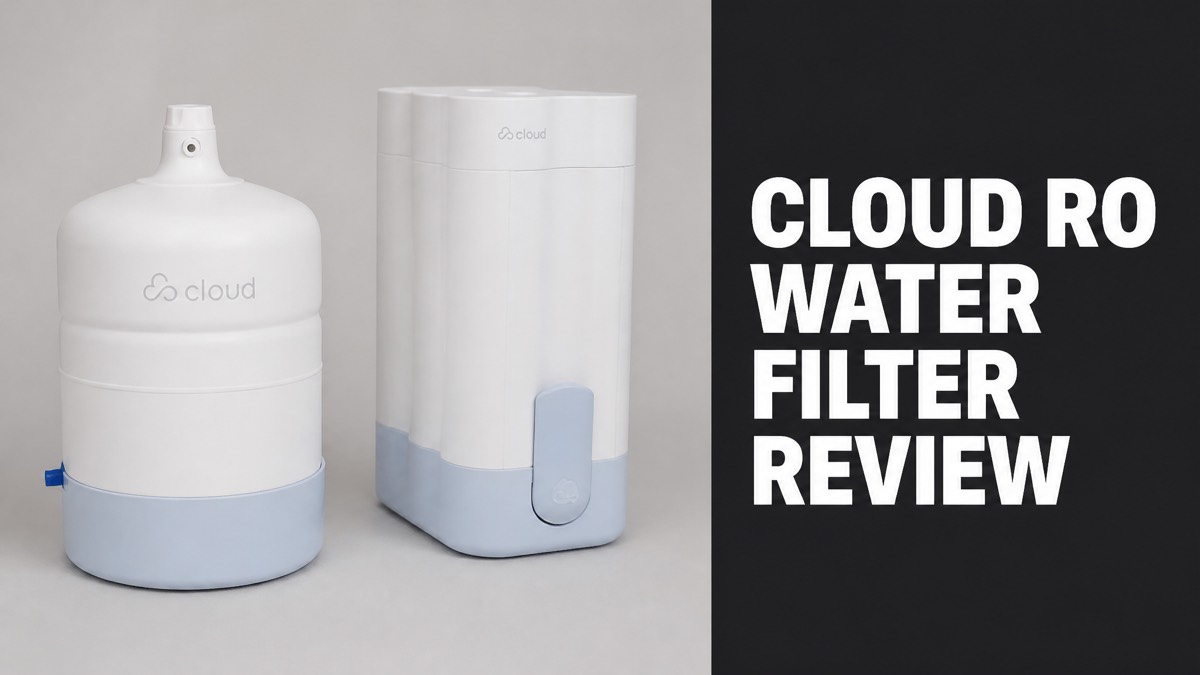
The Cloud RO is an under-sink reverse osmosis water filter from San Diego brand Cloud Water Filters. It pushes tap water through four stages, stores it in a 2.8-gallon tank, and delivers it from a dedicated faucet. A battery-powered monitor and phone app track water quality and filter life.
The system adds a remineralizing stage and a built-in pump. Lab tests cut dissolved solids by 90.4% on hard water, and waste runs near one gallon per gallon made. Installation needs drilling, and running costs reach about $200 a year. Owners praise the taste, while the lead and PFAS claims lack independent certification.
Buyers weighing a $599 purchase need the full picture. The sections below cover how the filters work, what the lab tests found, what owners report, how installation goes, and what the system costs to run. A clear verdict closes the review, so the choice rests on facts instead of marketing claims.
What Is the Cloud RO Water Filter?
The Cloud RO is an under-sink reverse osmosis system that filters tap water into a dedicated faucet. Cloud Water Filters sells it as a single product with four stages, a 2.8-gallon (10.6-liter) storage tank, and a battery-powered monitor. A phone app tracks water quality and filter life.
The unit targets households that want reverse osmosis without a bulky tankless machine. The filter housing fits beside the tank under most sinks. A stainless steel faucet, tubing, fittings, and a battery pack come in the box. The system carries NSF/ANSI 58 certification.
Published specs put the membrane at 50 gallons per day (189 liters) and faucet flow at 0.5 to 0.75 gallons per minute (1.9 to 2.8 liters). A glass fills in under six seconds. To put it simply, these numbers suit a household, not a restaurant.
Cloud RO Specs:
| Spec | Detail |
|---|---|
| Type | Under-sink reverse osmosis |
| Stages | Four |
| Storage tank | 2.8 gallons (10.6 liters) |
| Membrane capacity | 50 gallons per day |
| Power | Battery |
| Certification | NSF/ANSI 58 |
Who Makes the Cloud RO?
Cloud Water Filters is a San Diego, California company that sells one product, the Cloud RO. Ben Zvaifler and Nick Braun co-founded the brand. The company dates to 2020 and launched publicly in 2023.
A single-product catalog carries a real downside. No smaller, cheaper, or larger version exists if the first choice misses. Why does that matter? Buyers get one configuration and one price tier.
In plain English: third-party history stays thin. The brand's Trustpilot page carries only two reviews, too few to judge support quality. Owner feedback on retail pages fills part of that gap.
How Does the Cloud RO Work?
The Cloud RO pushes tap water through a sediment filter, a carbon block, a reverse osmosis membrane, and a remineralizing filter in that order. The membrane rejects dissolved contaminants to the drain. Clean water collects in the tank until the faucet opens.
An internal hydraulic pump holds pressure instead of relying on mains pressure. Why does that matter? The pump lets the system feed a refrigerator or ice maker. It also allows basement installs where pressure drops.
Battery-powered sensors track total dissolved solids (TDS), tank level, filter condition, and water use. The unit connects by Bluetooth to a phone app. The app also shows local water quality data pulled from a zip code.
What Does Each Filter Stage Do?
Each stage handles a separate job, from catching grit to restoring minerals. The sediment filter stops dirt, rust, and debris at 5 microns. The carbon block cuts chemical contaminants and volatile organic compounds, and it carries anti-scale media.
The reverse osmosis membrane removes dissolved solids, fluoride, and heavy metals. The remineralizing post-filter then adds back calcium, magnesium, and potassium. Those minerals raise pH and soften the taste.
Filter Stages:
| Stage | Job |
|---|---|
| Sediment | Stops dirt, rust, and debris |
| Carbon block | Cuts chemicals and VOCs |
| Reverse osmosis membrane | Removes dissolved solids, fluoride, heavy metals |
| Remineralizing filter | Adds calcium, magnesium, potassium |
Replacement timing differs by stage. The sediment and post-filter change about every six months, while the membrane and battery last about 18 months. Other schedules list a single yearly swap of the full set.
What Does the Cloud RO Remove From Water?
The Cloud RO cuts total dissolved solids and a long list of contaminants, including fluoride, heavy metals, and disinfection byproducts. Independent lab testing published by WaterFilterGuru showed a 90.4% TDS reduction on 707 ppm source water. Fluoride, uranium, copper, and all three disinfection byproducts fell to non-detectable levels.
A second test used cleaner water at 76 ppm. The system removed 100% of disinfection byproducts and fluoride there. Aluminum, copper, manganese, molybdenum, and strontium also dropped out.
The brand markets a 99% removal figure that covers PFAS, lead, microplastics, pesticides, and pharmaceuticals. Reverse osmosis as a method works well on these contaminants. Which proof is stronger? The lab figures above, since they are measured rather than claimed.
Is the Cloud RO Certified for Lead and PFAS?
No. The NSF/ANSI 58 certification covers total dissolved solids reduction and component material safety, not lead or PFAS. Cloud publishes reduction figures for both contaminants. Those figures come from the company's own testing.
Here's the thing: lead and PFAS are the two contaminants most buyers want gone. Does the method work on both? In principle, yes, so the gap is verification rather than likelihood. Buyers who need a certified lead answer must look at filters certified to NSF/ANSI 53.
The brand also reports third-party testing to NSF/ANSI 42, 53, and 401. A tap water test shows what the filter actually needs to handle. Run one before buying if a specific contaminant drives the purchase.
What Do Cloud RO Reviews Say?
Cloud RO reviews run strongly positive on taste, installation, and customer service. The brand's site shows 114 five-star ratings, and eight Amazon ratings average 4.4 stars. Editorial scores land lower, between 3.7 and 3.8 out of 5.
Why do owners and editors disagree? Editors mark the product down for price, running cost, and single-model range. Owners focus on taste and ease of use.
What Do Owners Like?
Owners praise the taste first, then the easy installation and the app. The remineralizing stage gives the water a smooth, balanced flavor. Many owners drink more water and stop buying bottles.
One household of three needed replacement filters only after a year and a half. Another owner installed the unit in 20 minutes with help. A condo owner fixed bubbly water by adding a pump on the support team's advice.
A taste comparison against city tap water found the tap water bitter and artificial by contrast. The Cloud water tasted smooth. The mineral stage gets the credit.
What Are the Common Complaints?
Complaints center on price, running cost, installation work, and a few reliability reports. One 2-star Amazon review describes a system that stopped delivering water after a year, with the app no longer supported. Support replaced a part earlier, but the fault returned.
Smaller gripes appear too. Gurgling after the first flush alarms new owners. Is it a fault? No, the manual calls it normal tank refilling. One owner wanted WiFi instead of Bluetooth for richer data.
Other limits come from the design. The system has no UV stage. The 2.8-gallon tank is moderate, and some rival models hold more. Tanks on reverse osmosis systems also need replacing every few years.
Common Complaints:
- High price
- About $200 a year to run
- Drilling required for install
- No UV stage
- Moderate tank size
- Bluetooth only
How Does the Cloud RO Compare to Waterdrop?
The Cloud RO trades tankless speed for a simpler battery-powered tank design, while Waterdrop sells many models with different features. Waterdrop is a wider brand founded in 2015 with under-sink, countertop, and whole-house products. Cloud sells one system.
Waterdrop's tankless systems use a booster pump that needs constant power. Cloud runs on a battery with no electrical work. Does a single model help? It removes the guesswork, though it removes choice too.
Waterdrop models often show TDS at the faucet, and most skip an app. Cloud tracks TDS, filter life, and usage in its app. Mineral blends vary by Waterdrop model, while every Cloud RO has the remineralizing stage.
Cloud RO vs Waterdrop:
| Feature | Cloud RO | Waterdrop |
|---|---|---|
| Design | Tank with battery | Tankless with booster pump |
| Monitoring | App tracks TDS, filter life, usage | TDS display, most skip an app |
| Range | One system | Many models |
| Minerals | Always included | Varies by model |
Which System Is Easier to Set Up?
The Cloud RO is easier to set up because it needs no outlet. Pre-cut tubing and labeled parts ship in the box. Most households finish in under an hour with basic tools.
Waterdrop installation varies by model. Units with hot water or UV sterilization need a power source and more space. Tankless models need power at all times.
How Hard Is the Cloud RO to Install?
Installation is a permanent under-sink job that most owners complete themselves in one afternoon. The maker quotes under an hour, and one owner finished in 20 minutes with help. Another needed about two hours and a trip for a larger washer.
Here's the catch: drilling is the main hurdle. The dedicated faucet needs a hole from 0.5 to 1.25 inches (1.3 to 3.2 cm) in the countertop, or it can reuse a sink sprayer hole. The drain line also needs a clamp and a hole. Renters need permission first.
Is the water ready right away? No. The first flush takes patience. The tank fills and drains three times before the water is ready, and one test measured over six hours of flushing. Plan the timing around that. Basic tools cover the rest: a Phillips screwdriver, an adjustable wrench, and a power drill.
The basic sequence runs short. Turn off the water supply and drill the faucet hole. Install the T-valve and drain clamp, connect the filters and battery, and attach the tubing. Turn the cold supply on and flush the tank three times.
Installation Steps:
- Turn off the water supply and drill the faucet hole.
- Install the T-valve and drain clamp.
- Connect the filters and battery.
- Attach the tubing.
- Turn the cold supply on.
- Flush the tank three times.
How Do You Replace the Filters?
Filter changes take a few minutes and need no tools. The filter magazine lifts out of the base, so owners swap cartridges on the countertop. Water flow shuts off automatically during the swap.
The app sends reminders and can reorder filters automatically. Replacement follows actual usage instead of a fixed calendar. A new battery ships with each filter kit.
How Much Does the Cloud RO Cost?
The Cloud RO lists at $749 and currently sells for $599. The price covers the system, tank, faucet, filters, battery pack, tubing, and fittings. Financing through Affirm starts at $47 per month.
By comparison, some competing smart systems run $1,000 to $2,000, while basic under-sink units cost a few hundred dollars less. The $599 price sits at the upper end for a basic under-sink system. Shipping is free in the continental US.
What Does It Cost to Run?
Running costs land near $200 a year, or about $0.18 per gallon. That covers the full filter set and battery. Pre-filter and post-filter swaps come about every six months, with the membrane and battery near 18 months.
Cloud RO Costs:
| Item | Amount |
|---|---|
| List price | $749 |
| Current price | $599 |
| Financing | $47 per month |
| Filters per year | About $200 |
| Cost per gallon | About $0.18 |
The figure sits at the high end. The APEC ROES-50 runs roughly $80 a year. So what does the extra spend buy? The near 1:1 waste ratio, the pump, and a longer warranty.
The good news? Water savings offset part of that. Typical reverse osmosis wastes three to four gallons (11 to 15 liters) per gallon made, while the Cloud RO measured about 1.03 gallons (3.9 liters). A household drinking 2 gallons (7.6 liters) a day saves roughly 2,000 gallons (7,570 liters) a year.
Warranty terms differ between listings. Published coverage ranges from 12 months to five years. A 12-month money-back guarantee carries no restocking fee, so confirm the warranty term at checkout.
Is the Cloud RO Worth It?
Yes. The Cloud RO is worth it for buyers who want low water waste, a battery-powered tank system, and easy filter changes. Measured lab results back its core filtration claims. The price and running cost make it a premium choice.
To be clear, the weak points are real. Lead and PFAS figures lack independent certification, the brand has little third-party history, and one buyer reported a failure after a year. Is it a budget pick? No, budget buyers find cheaper systems. Bottom line: buy it for the low waste and easy upkeep, not for the price.
Who Should Skip the Cloud RO?
Price-led buyers, renters who cannot drill, and shoppers who need a certified lead answer are better served by another system. The brand offers only one model. No cheaper or larger option exists to move to.
The strengths are a near 1:1 waste ratio, remineralized taste, app monitoring, tool-free filter swaps, and a 12-month return window. The costs are the $599 price, about $200 a year in filters, drilling for install, uncertified lead and PFAS claims, and a single model.
Pros:
- Near 1:1 waste ratio
- Remineralized taste
- App monitoring
- Tool-free filter swaps
- 12-month return window
Cons:
- $599 price
- About $200 a year in filters
- Drilling for install
- Uncertified lead and PFAS claims
- Single model
Pop Kitchen is a reader-supported platform. Purchases made through our links may earn us an affiliate commission at no extra cost to you.