
Clearsource Ultra RV Water Filter System Review: Is It Worth the Price?
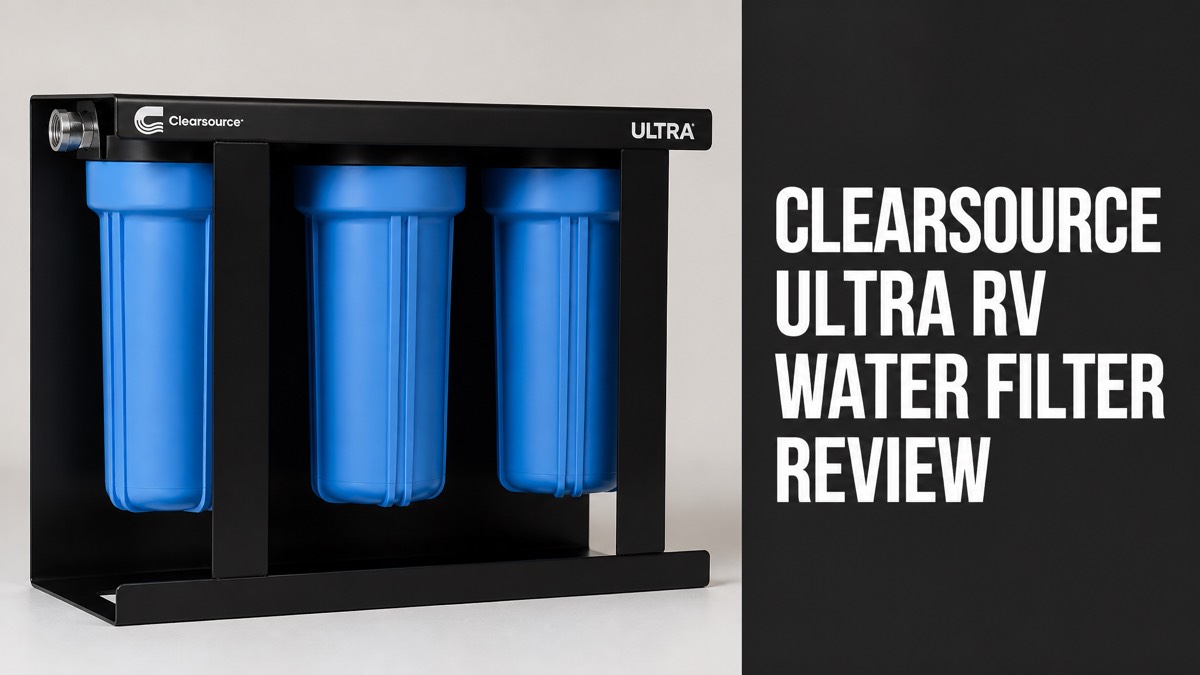
The Clearsource Ultra RV Water Filter System is a free-standing, three-canister filter for RVs. The unit sits between the campground spigot and the RV water inlet. The system combines a sediment filter, a carbon block, and a VirusGuard stage to clean drinking water on the road.
Three filter stages remove sediment, chemicals, and pathogens. Installation takes about 15 minutes without tools. Water pressure stays steady, and the taste improves noticeably. The frame is rugged powder-coated metal, though the unit weighs roughly 28 pounds (12.7 kilograms). The first filter set and a wrench come in the box.
Replacement filters and the upfront price are the main costs. Full-timers recoup the money fastest by skipping bottled water. Read on for filter details, specs, comparisons, and a verdict on whether the Ultra deserves a place in an RV. Each section answers one buyer question.
What Is the Clearsource Ultra RV Water Filter System?
The Clearsource Ultra is a three-canister drinking water filter built for RVs. Clearsource sells it as a free-standing unit that sits between the campground spigot and the RV's fresh water inlet.
The Ultra is the top external model in the Clearsource line. The unit ships fully assembled, with filters already installed in the canisters. A wrench for later filter changes comes in the box.
Think of it as a whole-RV filter, not a pitcher or a faucet add-on. Every faucet and shower downstream gets filtered water. So why does that matter on the road? Campground water quality changes from site to site.
Who Is the Clearsource Ultra For?
The Ultra suits full-time RVers and frequent campers who fill up from unknown water sources. Campgrounds on well water and gas station fill-ups are the typical trouble spots.
Weekend campers can use it too. The filter schedule stretches to once a year for occasional trips. The price is the real hurdle for casual campers, not the performance.
Anyone who wants protection from viruses, not only bacteria and cysts, is the ideal buyer. Basic inline filters stop at sediment and cannot offer that.
How Does the Clearsource Ultra Work?
The Clearsource Ultra pushes incoming water through three filters in a row. Each stage targets a different group of contaminants, so the water gets cleaner at every step.
Campground water pressure does all the work. Why does the unit need no power? Spigot pressure alone pushes water through all three canisters. Connect the hoses, open the tap, and the water flows through all three canisters on its way to the RV.
The canisters are oversized. Clearsource says the bigger housings keep flow high, so pressure holds steady even with several fixtures running. Short answer: the filters do not starve the plumbing.
What Does Each Filter Stage Do?
Stage one removes rust and sediment with a 5-micron filter. Stage two is a 0.5-micron coconut shell carbon block. Stage three is the VirusGuard filter. Here's the quick breakdown:
Filter Stages:
| Stage | Filter | Main Targets |
|---|---|---|
| 1 | 5-micron filter | Rust, scale, silt, sediment |
| 2 | 0.5-micron coconut shell carbon block | Chlorine, chloramines, volatile organic compounds, pesticides, taste and odor |
| 3 | VirusGuard filter | E. coli, Giardia, viruses |
The carbon block handles taste and smell. The stage also cuts chlorine, chloramines, volatile organic compounds, pesticides, and petrochemicals. Chlorine and organic compounds carry most of the odor in campground water. Remove them and the smell fades.
Order matters. The sediment filter goes first so rust and silt never clog the finer filters behind it. The carbon stage then works on dissolved chemicals before the water reaches the final stage.
What Is VirusGuard?
VirusGuard is the Clearsource-exclusive third stage that targets viruses as well as bacteria and cysts. The maker says the design uses technology developed by NASA.
The filter uses an electrically charged coating to trap even tiny viruses. Clearsource argues that a plain 0.2-micron filter lets most small viruses pass. Why? Only filters with an absolute rating guarantee that pore size.
The claim comes from the manufacturer. Buyers who want proof can ask Clearsource for its test data. Still, the third stage is what separates the Ultra from the two-stage Clearsource Premier.
What Are the Clearsource Ultra Specs and Build Quality?
The Ultra measures about 18.75 by 15.25 by 7.5 inches (47.6 by 38.7 by 19.1 centimeters). The weight is roughly 28 pounds (12.7 kilograms). The maximum flow rate is 4.5 gallons (17 liters) per minute.
Key Specs:
| Spec | Detail |
|---|---|
| Dimensions | 18.75 x 15.25 x 7.5 inches |
| Weight | About 28 pounds |
| Maximum flow rate | 4.5 gallons per minute |
| Filter stages | Three |
| Filter life | 2,000 gallons per set |
| Chassis | Powder-coated metal |
| Fittings | Stainless steel |
The chassis is powder-coated metal. The hose connections are stainless steel. Only the canisters and their heads are plastic. The canister tops are bolted through the body and do not wiggle at all.
The frame is built and powder-coated in the USA. Clearsource says the filter cartridges and canisters come from a California supplier that manufactures in Taiwan.
How Heavy and Durable Is the Clearsource Ultra?
The Ultra is heavy enough to stay put in high winds. Shipping weight lands near 30 pounds (13.6 kilograms), and nearly all of that is the unit itself.
The heft cuts both ways. Hauling it in and out of a storage bay is a chore. Does that matter much? Full-timers who leave water inside the canisters feel it most.
A price near $350 in 2020 also made theft a real concern. Locking the unit to the RV or keeping it in the wet bay is smart. Unattended units at a campsite are easy to walk off with.
Does the Clearsource Ultra Improve Taste and Smell?
Yes. The Clearsource Ultra removes bad tastes and odors from campground water, sulfur smells included.
One long-term resident filtered water through a Camco and then a Brita just to make it palatable. After hooking up the Ultra, the water ran crystal clear with no odor. Is the Brita still needed? No, that step is gone.
Laundry improved too. Clothes that once picked up a faint sulfur smell now smell only like detergent. The water also tastes clean, with no chemical or metallic aftertaste.
Does the Clearsource Ultra Reduce Water Pressure?
No. The Clearsource Ultra holds water pressure steady, even with several faucets running.
Cheap inline filters are the usual culprit for weak showers. Why? Their small housings choke the flow. The Ultra uses oversized canisters and a 4.5 gallons-per-minute (17 liters-per-minute) rating to avoid that.
One RVer who had tried several filters saw no noticeable drop after installing the Ultra. Showers kept working normally, which was the main complaint with earlier inline filters.
Is the Clearsource Ultra Easy to Install?
Yes. The external Clearsource Ultra installs without tools in about 15 minutes.
Setup follows a simple sequence. The list below covers every move.
Installation Steps:
- Connect a hose from the campground spigot to the filter inlet.
- Connect a second hose from the filter outlet to the RV water inlet.
- Open the water slowly and check every connection for leaks.
- Run water through the unit for a few minutes to flush the filters.
The flush matters. Carbon filters shed black dust at first. Why does the water look gray at the start? Fresh carbon sheds fine dust, and the water runs clear after a short flush.
One gap: the box has no hose. A short 4-foot (1.2 meter) hose between the spigot and the filter is a separate purchase. A sturdier supply hose from the spigot helps too.
How Do You Store the Clearsource Ultra Between Trips?
Short breaks need no special prep. If the next trip starts within a week or two, leave the unit as it is.
Longer storage takes a few steps. For a month or more, unscrew the canisters and pour out the water. Move the filter elements to dry storage. The elements can dry out and get wet again without harm.
Winter needs extra thought. An external unit is hard to insulate, so owners staying put through a freeze lean toward the onboard model. Clearsource also sells a WeatherGuard accessory for the Ultra.
How Often Do the Clearsource Ultra Filters Need Replacing?
Each set of Clearsource Ultra filters is rated for 2,000 gallons (7,570 liters) of water. Actual change intervals depend on how often the RV is in use.
Clearsource's guidance is simple. Occasional campers replace the set once a year. Frequent weekenders replace it twice a year. Full-timers replace it every two to three months.
Replacement Schedule:
| Use Pattern | Replace Filters |
|---|---|
| Occasional camper | Once a year |
| Frequent weekender | Twice a year |
| Full-timer | Every 2 to 3 months |
Dirtier incoming water shortens the interval. Very dirty cartridges at changeout are proof that the filters are catching the right contaminants.
How Much Do Replacement Filters Cost?
A genuine replacement three-pack currently lists at C$93.44 on Amazon Canada, roughly C$31 per filter.
Early buyers paid much less. A 2020 estimate put a full set near $40. Another listing priced the 5-micron filter at $11 and the carbon element at $20.
Genuine packs carry the ASIN B08MWSRHRG on Amazon. Cheaper compatible packs exist, though the VirusGuard filter is a Clearsource-exclusive design.
How Does the Clearsource Ultra Compare With Other RV Water Filters?
The Clearsource Ultra filters far finer than a standard blue inline filter. A Camco-style inline unit holds a 100-micron filter. The Ultra steps down from 5 to 0.5 microns and adds a virus stage.
Filter Comparison:
| Filter | Stages | Fine Filtering | Pathogen Protection |
|---|---|---|---|
| Camco-style inline | 1 | 100 micron | None |
| Clearsource Premier | 2 | 0.2 micron absolute | Bacteria and cysts |
| Clearsource Ultra | 3 | 5 and 0.5 micron plus VirusGuard | Bacteria, cysts, and viruses |
Inline filters cost about $20 and are built to be thrown away. Is that a bargain? Not quite, since plastic hose threads strip easily and flow often drops.
The Clearsource Premier pairs two stages with absolute-rated 0.2-micron filters. Clearsource says that rating blocks bacteria like E. coli and cysts like Giardia. The Ultra adds VirusGuard on top for viruses.
Rival three-stage kits include the Blu Tech AR3, the Glacier Fresh, and the VEVOR. Those lean on 0.2-micron or 5-micron filters. Clearsource claims no other RV filter offers its level of virus protection.
How Does the Clearsource Ultra Compare With a Berkey?
A Berkey filters only the water poured into it. Sinks and the rest of the plumbing stay open to whatever the campground sends.
One RVer loves a Berkey so much that a Berkey shower head came along too. Even so, that setup left the sinks unfiltered. Great at its job, but not enough on its own.
The Ultra sits upstream of the RV plumbing. Every tap gets protection, and the pipes see cleaner water. A whole-system filter covers the gap a countertop unit leaves.
How Much Does the Clearsource Ultra Cost?
The Clearsource Ultra costs several hundred dollars, and the price has risen since launch. Buyers paid $350 on Amazon in 2020.
A current Amazon Canada listing shows C$708.59 from a third-party seller. Prices vary by seller and region, so check live listings before buying.
The first set of filters and a wrench come with the system. A short supply hose is the usual extra purchase.
Is the Clearsource Ultra Worth the Price?
Yes. The Clearsource Ultra pays for itself when the alternative is buying bottled water.
The math is simple. One estimate for a similar Clearsource system put filter costs near 33 cents a day for a full-timer changing quarterly. A gallon of bottled water runs about $1.50. How fast does that pay back? In a few months for heavy drinkers.
A weekend camper rarely recoups the cost in water savings alone. Taste and safety are the main returns in that case.
Clearsource Ultra: Final Verdict
The Clearsource Ultra is a well-built, effective filter system with a high price. Owners praise the taste, the steady pressure, and the rugged frame.
The virus-specific stage makes it the stronger pick for full-timers and for campers parked on well water. Nothing in the inline class matches its filtering depth.
Pros:
- Three-stage filtering with a dedicated virus stage
- Steady water pressure
- Clean taste and no sulfur smell
- Tool-free installation
- Rugged powder-coated metal frame
What Are the Downsides of the Clearsource Ultra?
The biggest downside is the price, followed by the weight. The unit costs several hundred dollars, and hauling roughly 28 pounds (12.7 kilograms) gets old.
The box has no hose, and replacement filters add up for full-timers. Is that a dealbreaker? For most buyers it is a small annoyance next to the upfront cost.
Cons:
- High upfront price
- Weighs roughly 28 pounds
- No supply hose included
- Replacement filters cost real money over time
- External unit is hard to insulate in winter
Bottom line: buy the Ultra if you live in your RV or camp on well water. Casual campers on a tight budget can drop down to the Premier or a basic inline filter.
Pop Kitchen is a reader-supported platform. Purchases made through our links may earn us an affiliate commission at no extra cost to you.