
Clack Whole House PFAS Water Filter Review: Is It Worth It?
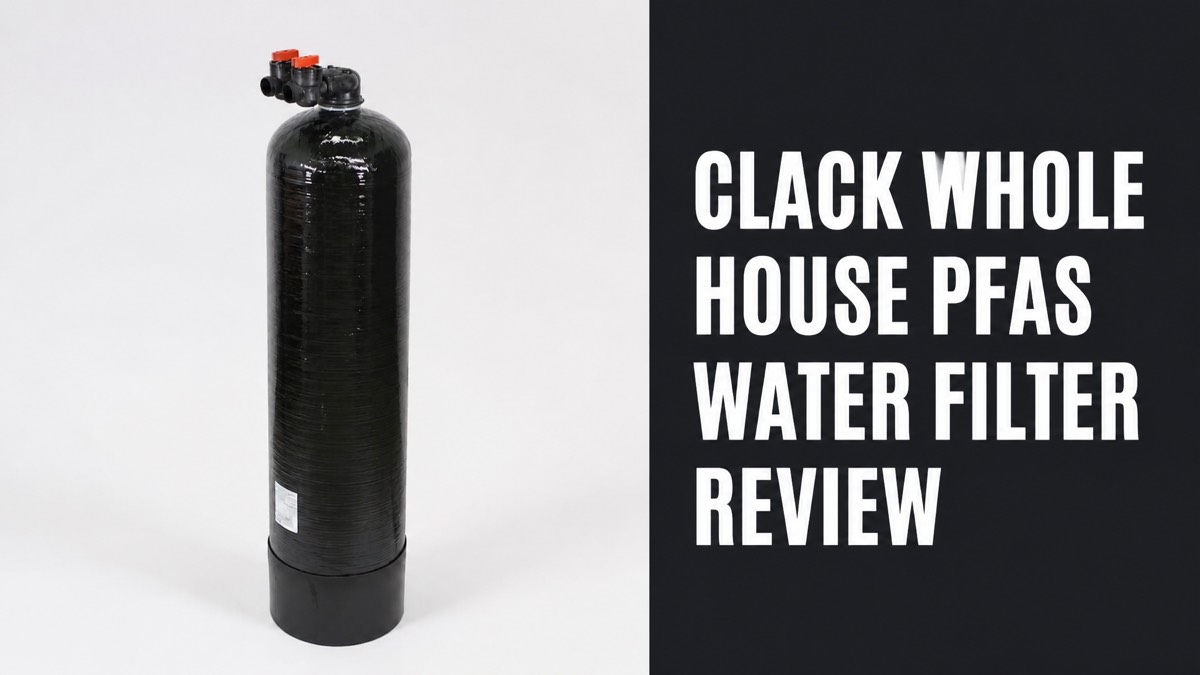
The Clack Whole House PFAS Water Filter is a point-of-entry system that treats every tap in a home for PFAS. The system pairs a C-Series control head with a 12x48 inch (30x122 cm) tank of ResinTech SIR-110-HP ion exchange resin. Aqua Home Supply sells it with a 10 year warranty.
The resin captures PFAS instead of carbon and needs no backwash. Specs include 2.0 cubic feet of media, 8 GPM of flow and a 12 to 24 month media life. The product claims non-detect removal, yet no whole-system certification appears in its details. Hard water above 10 grains per gallon needs softening first.
Alternatives such as SpringWell, iSpring and a certified under-sink RO unit trade flow, price and certification differently. Running costs center on resin changes, and annual PFAS tests verify results. Read on to see who should buy it, who should skip it and what the honest verdict is.
What Is the Clack Whole House PFAS Water Filter?
The Clack Whole House PFAS Water Filter is a point-of-entry system that treats every tap in a home for PFAS. The system pairs a C-Series control head with a 12x48 inch (30x122 cm) resin tank. The tank ships pre-loaded with ResinTech SIR-110-HP media.
Here's the thing: Clack is the valve brand. The control head and bypass manage flow, and the resin does the actual PFAS work. So the hardware stays familiar to plumbers while the media handles the chemistry.
The target is PFAS, a family of chemicals used in nonstick cookware, water-resistant fabrics and firefighting foam. Why the nickname forever chemicals? They do not break down in the environment or in the body.
What Does the Clack PFAS Filter Include?
The package includes the control head, tank, bypass, media and basket. Buyers get the C-Series control head, a 12x48 inch resin tank, a C-Series bypass and a choice of bypass fittings.
Included:
- C-Series control head
- 12x48 inch (30x122 cm) resin tank
- C-Series bypass with your choice of fittings
- ResinTech SIR-110-HP media, pre-loaded
- Upper basket and gravel under bed
The resin arrives pre-loaded in the tank. An upper basket and a gravel under bed sit inside the vessel. And that means loading media by hand isn't part of the install.
And the coverage is solid: free shipping within the US, a 10 year warranty and 120 day returns. A free replacement parts for life program adds long-term backup.
How Does the Clack PFAS Filter Work?
The filter captures PFAS with ion exchange resin instead of plain carbon. Water moves through a bed of SIR-110-HP beads. The beads hold PFAS molecules while clean water continues to the house.
Let me break that down: the resin combines ion exchange with adsorption. PFAS molecules bind their water-loving heads to ionic sites on the beads. Their oil-loving tails then adsorb to the resin surface.
Systems built on this media do not regenerate. Does that mean extra plumbing? No. They need no backwash, no drain line and no salt. Once the resin is spent, the owner replaces it.
Why Does Ion Exchange Resin Beat Carbon for PFAS?
Resin offers higher capacity and faster contact than carbon. Ion exchange resin such as SIR-110 holds up to 10 times the PFAS capacity of activated carbon. Longer media life follows from that capacity.
Resin also handles both long-chain and short-chain PFAS, while activated carbon performs best on long-chain compounds. Why does that range matter? Thousands of PFAS compounds exist.
Faster kinetics mean less contact time. So tanks stay compact, and this system occupies 13 inches by 17 inches (33x43 cm) of floor space.
But carbon still works. The EPA found that carbon, ion exchange and reverse osmosis point-of-use systems can all greatly reduce PFAS. Maintenance on schedule is the condition.
What Are the Clack PFAS Filter Specs?
The tank holds 2.0 cubic feet (57 liters) of resin and flows 8 GPM (30 liters per minute). The vessel measures 12x48 inches. Media life runs 12 to 24 months. The footprint is 13 inches wide by 17 inches deep.
Key Specs:
| Spec | Value |
|---|---|
| Tank size | 12x48 inches (30x122 cm) |
| Resin volume | 2.0 cubic feet (57 liters) |
| Flow rate | 8 GPM (30 liters per minute) |
| Media life | 12 to 24 months |
| Footprint | 13 by 17 inches (33x43 cm) |
| PFAS removal claim | Non-detect levels |
The product claims PFAS removal to non-detect levels. Is that claim proven for the whole system? Product details show no independent whole-system test result, so a before-and-after water test confirms it in a given home.
Buyers choose their bypass fittings at checkout. And the pre-loaded media removes a messy setup step.
The tank body is 48 inches (122 cm) tall and 12 inches (30 cm) wide. Keep in mind, the control head adds height on top of that.
Is the 8 GPM Flow Rate Enough for a Home?
Yes. 8 GPM (30 liters per minute) covers peak use in an average home. Whole-house PFAS guidance puts household demand between 8 and 15 GPM (30 to 57 liters per minute).
But one caveat applies. A separate sizing chart for 2.0 cubic foot resin tanks lists 8 GPM as peak flow. The same chart lists 4 GPM (15 liters per minute) as continuous flow. Long, steady draws such as irrigation need the lower number.
Large households sit near the top of the demand range. Does that cause trouble? Potentially. Several showers plus a washing machine can strain an 8 GPM system.
Does the Clack PFAS Filter Actually Remove PFAS?
Yes. The SIR-110-HP media targets PFOA, PFOS, PFNA and other PFAS compounds. Ion exchange resin has a strong chemistry case against these chemicals.
The product claims non-detect PFAS levels. Is there a published whole-system test behind it? Not in the product details. The media performance and the system performance are two separate questions.
In plain English: annual PFAS testing settles the question for a given home. One sample goes before the system and one after.
Is the Clack PFAS Filter Certified?
No. No whole-system certification appears in the product details. The SIR-110-HP resin itself carries a WQA Gold Seal. The seal covers the media, not the assembled tank and valve.
The EPA tells buyers to look for NSF/ANSI 53 or 58 certification for PFAS reduction. Accepted certifiers include NSF, CSA Group, IAPMO R&T, UL and WQA.
Here's why that matters: certification is rare at whole-house scale. Why? High flow rates make the test brutal, so very few whole-house systems hold an official PFAS listing. The Enpress PIONEER is one of them.
To be clear, the EPA also notes a gap. Current standards do not yet show filters meeting its new limits. Those limits are 4 parts per trillion for PFOA and PFOS.
Who Should Avoid the Clack PFAS Filter?
Homes with nitrate problems should look at a regenerating nitrate system instead. The resin system does not regenerate, so it does not remove nitrate. The system does remove perchlorate.
Poor Fits:
- Homes with nitrate problems
- Homes that have not tested for PFAS
- Buyers who only care about drinking water
Homes without a PFAS test should test first. Why? PFAS is a group of chemicals and concentrations vary widely. A lab panel shows which compounds are present and at what level.
Buyers who only care about drinking and cooking water can spend less. A point-of-use reverse osmosis unit covers the kitchen tap for a lower price.
But whole-house coverage earns its cost when bathing exposure matters. PFAS enters the body through skin and steam during hot showers, and children absorb more than adults.
Does Hard Water Hurt the Clack PFAS Filter?
Yes. Hardness above 10 grains per gallon (171 milligrams per liter) can foul the resin bed. Hardness precipitates inside the media and coats the beads.
A fouled bed raises pressure drop and cuts flow. Weak showers and starved appliances follow. The water ends up treated slowly or not at all.
The fix is simple: a softener ahead of the PFAS tank. Soft water reaches the resin, and the resin keeps its capacity.
Well water needs the same care. Iron, sediment and hardness need pretreatment before the PFAS stage can do its job.
How Does the Clack PFAS Filter Compare to SpringWell and iSpring?
The Clack system uses resin while SpringWell and iSpring use other media. SpringWell relies on ATOMUS PF8 adsorption media. iSpring builds a multi-stage design around sediment, KDF and a PFAS carbon stage.
Side by Side:
| System | Media | Flow Rate | Notable Detail |
|---|---|---|---|
| Clack PFAS filter | Ion exchange resin | 8 GPM (30 L/min) | 10 year warranty |
| SpringWell PFAS system | ATOMUS PF8 adsorption media | 7 GPM (26 L/min) | 350,000 gallon rating (1.3 million L) |
| iSpring WGB32B-PF | Multi-stage carbon and KDF | Up to 15 GPM (57 L/min) | Around $750 |
SpringWell rates its PFAS system at 350,000 gallons (1.3 million liters) and 7 GPM (26 liters per minute). The tank is 8x40 inches, and a lifetime warranty applies. The system serves one to five bathrooms.
By comparison, the iSpring WGB32B-PF is SGS-tested to reduce up to 99% of PFOA and PFOS. The unit flows up to 15 GPM (57 liters per minute) and costs around $750.
So what does that mean for you? Clack trades flow for resin capacity and a strong guarantee. Buyers get a 10 year warranty and a free replacement parts program, while iSpring flows nearly twice as fast.
How Does It Compare With a Certified Under-Sink RO?
A certified under-sink RO system typically costs less and has stronger certification evidence. NSF/ANSI 58 systems can list explicit PFOA and PFOS reduction. Buyers verify the listing at info.nsf.org.
RO covers one or two taps only. The EPA cites a price range of $150 to $1,000 and about one gallon of waste per gallon treated. Showers and laundry get nothing.
And many families layer both. A whole-house system handles general reduction, and an RO unit at the kitchen tap handles drinking and cooking water.
How Much Does the Clack PFAS Filter Cost to Run?
Running costs center on replacing the resin every 12 to 24 months. The spec details show no purchase price, so buyers check the live listing. Resin replacement is the recurring line.
Resin lasts longer than carbon. Why does that save money? Up to 10 times the capacity of activated carbon means fewer media changes, so maintenance costs fall.
The system uses no salt and no backwash water. Regeneration chemicals aren't part of the routine either.
A 10 year warranty and a free replacement parts for life program limit hardware risk. And those two items offset some of the upfront cost.
How Often Does the Media Need Replacing?
The media lasts 12 to 24 months under normal use. Water volume and PFAS concentration move the timeline. Higher contamination shortens it.
Spent resin gets replaced, not regenerated. Nothing in the routine restores it. So the owner plans a media change at the interval.
Overdue media is a real risk. What happens past capacity? Filters run past capacity can let contaminants through or release trapped ones back into the water.
The EPA stresses that filters only work when maintained as the manufacturer directs. And annual PFAS tests show when the resin is nearing its limit.
Is the Clack PFAS Filter Worth It?
Yes. The Clack PFAS filter is worth it for homes with confirmed PFAS and soft water. Its resin chemistry, long media life and 10 year warranty make a strong package.
The strengths are concrete. Resin holds more PFAS than carbon, there's no backwash, and the media lasts 12 to 24 months. The warranty and parts program back the hardware.
The caveats are concrete too. No whole-system certification appears in the product details, 8 GPM is a peak rating, and hard water needs softening first. Price isn't listed in the specs. Bottom line: a good buy once a test confirms PFAS and the water is soft.
What Are the Pros and Cons of the Clack PFAS Filter?
The pros center on resin performance and warranty. Resin offers high capacity, covers long-chain and short-chain PFAS, and needs no backwash. The footprint is small and the warranty runs 10 years.
Pros:
- High PFAS capacity from ion exchange resin
- Covers long-chain and short-chain PFAS
- No backwash, drain line or salt
- 10 year warranty and free replacement parts program
- Compact 13 by 17 inch footprint
Cons:
- No whole-system certification in the product details
- Does not remove nitrate
- Hardness above 10 grains per gallon needs softening first
- 4 GPM continuous rating on a 2.0 cubic foot resin tank
The cons center on certification and limits. No whole-system listing appears in the product details. The system skips nitrate, dislikes hard water, and flows 4 GPM continuous.
The decision path is simple: test the water. Soften it if hardness tops 10 grains per gallon. Install the system, then run a follow-up PFAS test to confirm the result.
Pop Kitchen is a reader-supported platform. Purchases made through our links may earn us an affiliate commission at no extra cost to you.